What Is the Crypto Fear and Greed Index?
The crypto fear and greed index is a simple way to understand what’s really driving the market. Instead of reacting to price swings, you can use it to read investor sentiment, avoid emotional decisions, and make more informed moves in crypto.

Key Takeaways
- The crypto fear and greed index measures market sentiment on a scale from 0 (extreme fear) to 100 (extreme greed).
- Crypto prices are heavily influenced by emotions like fear and greed, not just fundamentals.
- The index works best when combined with other tools like price charts and technical indicators.
Crypto prices don’t just rise and fall for technical reasons. They surge on hype, drop on panic, and often move faster than logic can explain. To make sense of that, you need more than charts. You need to understand sentiment. The crypto fear and greed index helps you do exactly that.
In this guide, you’ll learn what the crypto fear and greed index is, how it works, and how to use it to make more informed decisions.
What Is the Fear and Greed Index in Crypto?
The crypto fear and greed index measures overall market sentiment by combining multiple signals into a single score from 0 to 100. This score shows whether the market is driven more by fear or greed at any given time.
Rather than analyzing multiple indicators separately, it simplifies market behavior into one clear metric. This is why the fear and greed index is widely used as a quick way to understand market sentiment.
What Does the Fear and Greed Index Measure in Crypto?
The crypto fear and greed index tracks overall market sentiment by analyzing factors like volatility, trading volume, market trends, and social activity. These signals reflect how investors are behaving. For example, investors may act cautiously or chase momentum.
High fear often leads to selling or hesitation, while strong greed can drive aggressive buying.
Why the Fear and Greed Index Matters in Crypto Trading
Crypto markets are driven as much by emotion as by fundamentals. Prices often reflect how investors feel, whether that is fear, panic, or hype, not just underlying data.
The crypto fear and greed index helps you see that emotional layer clearly. By showing where the market sits on the fear-to-greed scale, it gives you context behind price movements and helps you avoid reacting impulsively.
Instead of following the crowd, you can step back, understand what is driving sentiment, and make more rational decisions, especially when the market is moving quickly.
How Fear and Greed Drive Crypto Market Prices
Every major price move in crypto is influenced by fear and greed. These emotions drive behavior, and that behavior directly impacts crypto prices.
- When fear takes over, people sell quickly to avoid losses → prices drop
- When greed kicks in, people rush to buy → prices rise rapidly
This creates a cycle:
rising prices → excitement → overbuying → correction → panic selling
Once you recognize this pattern, you start to see that price movements aren’t random; they’re emotional reactions happening at scale. The crypto fear and greed index captures this cycle in a simple, easy-to-read format.
How the Fear and Greed Index Reflects Market Sentiment
The crypto fear and greed index takes all of that emotional behavior and turns it into a simple score you can understand at a glance. Instead of guessing how the market feels, you get a clear view of the overall market mood index.
This helps you:
- Stay calm when others are panicking
- Avoid chasing hype when the market is overheated
- Make decisions based on context, not impulse
In simple terms, the index acts like a reality check. It helps you step back, see the bigger picture, and avoid getting caught up in the crowd.
How Is the Crypto Fear and Greed Index Calculated?
The crypto fear and greed index doesn’t rely on just one metric; it pulls data from different sources to understand how investors are behaving overall. Each data point reflects either fear or greed in the market. These signals are then weighted and combined to produce a score between 0 (extreme fear) and 100 (extreme greed).
The goal is to turn something abstract, like emotions, into something measurable and easy to understand.
What Data Is Used in the Fear and Greed Index?
The fear and greed index uses a mix of data points to track the overall market mood index. Instead of guessing how people feel, it looks at real activity in the market to determine whether fear or greed is dominating.
Here are the main factors that go into the calculation:
Volatility and Market Risk (Fear Signal)
Volatility measures how quickly and sharply prices are changing. When the market becomes highly volatile, especially after sudden drops, it’s usually a sign of fear.
If prices are swinging aggressively or crashing, investors tend to panic and sell. The index picks up on this and leans more toward the “fear” side.
Trading Volume and Market Momentum (Greed Signal)
Trading volume shows how much activity is happening in the market. When volume increases alongside rising prices, it often signals strong interest and growing confidence.
This is usually driven by greed. People buy in because they expect prices to keep going up. The stronger the momentum, the more the index shifts toward greed.
Social Media and Trends (Sentiment Signals)
The index also looks at what people are saying and searching for online. Increased mentions of crypto on platforms like X (Twitter), Reddit, or Google Trends can signal growing excitement or hype.
When conversations spike and engagement rises, it’s often a sign that greed is building. On the flip side, reduced activity can reflect uncertainty or fear.
Bitcoin Dominance in the Fear and Greed Index
The bitcoin fear and greed index also considers Bitcoin’s dominance—how much of the total crypto market is made up of Bitcoin.
When Bitcoin dominance rises, it can signal that investors are moving funds into what they see as a “safer” asset, which often reflects fear. When dominance drops, it suggests investors are taking more risks with altcoins, which leans toward greed.
By combining all of these signals, the index creates a clearer picture of what’s really driving the market. Instead of relying on guesswork, you get a data-backed view of whether fear or greed is in control.
Fear and Greed Index Meaning: What the Scores Tell You
Understanding the fear and greed index meaning is key to actually using it well. The crypto fear and greed index gives you a number between 0 and 100, but what really matters is what that number says about how people are behaving in the market.
Think of it as a temperature check for investor emotions. Lower scores mean fear is taking over, while higher scores mean greed is driving decisions.
Fear and Greed Index Scale Explained (0–100)
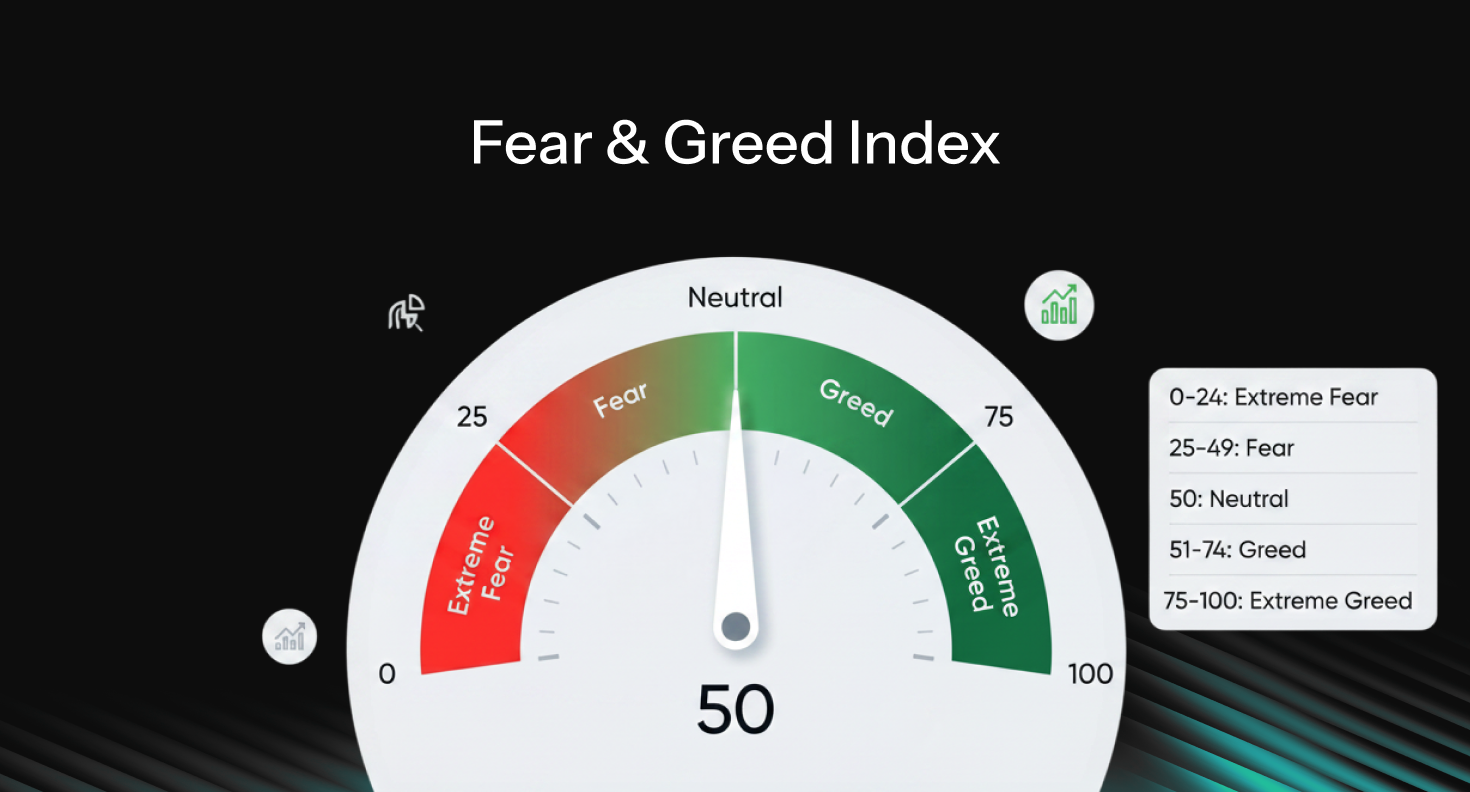
The fear and greed index is broken down into simple ranges that show how the market is feeling:
- 0-24 (Extreme Fear): High panic, heavy selling
- 25-49 (Fear): Caution, uncertainty
- 50 (Neutral): Balanced sentiment
- 51-74 (Greed): Growing confidence, more buying
- 75-100 (Extreme Greed): Overconfidence, possible market overheating
This scale makes it easy to quickly understand the mood of the market without digging through charts or data.
What Extreme Fear Means in the Fear and Greed Index Crypto
When the fear and greed index crypto score drops into extreme fear, it usually means investors are worried and selling aggressively. Prices may be falling quickly, and the overall mood is negative.
For beginners, this can feel like the worst time to be in the market; but it’s often when opportunities start to appear. Extreme fear can signal that assets are being sold off too quickly, sometimes below their actual value.
What Extreme Greed Means in the Fear and Greed Index Crypto
When the greed and fear index moves into extreme greed, it means the market is full of confidence; sometimes too much. Prices are rising, and more people are jumping in, often driven by excitement or fear of missing out.
While this can look like a strong market, it can also be a warning sign. Extreme greed often comes before corrections, when prices drop after being pushed too high too quickly.
How to Use the Crypto Fear and Greed Index with Other Indicators
The crypto market can be unpredictable, which is why it’s important not to rely on just one tool. While the crypto fear and greed index is great for understanding market sentiment, it works best when combined with other indicators that show price trends, momentum, and overall market structure.
Think of the index as a mood check, not a complete strategy. It tells you how people feel; but you still need other tools to decide what to do next.
Using the Fear and Greed Index with Price Charts
Start with the basics: price charts. Look at how the market is actually moving; whether it’s trending up, down, or sideways.
- If the index shows extreme fear and prices are stabilizing, it could signal a potential buying opportunity
- If the index shows extreme greed and prices are already very high, it may suggest caution
This combination helps you avoid acting purely on emotion or hype.
Combining the Fear and Greed Index with Technical Indicators
You can pair the index with simple technical indicators to get a clearer picture:
- Moving averages: Show overall trend direction
- RSI (Relative Strength Index): Indicates if an asset is overbought or oversold
- Support and resistance levels: Highlight key price zones
For example, if the market sentiment is fearful and RSI shows oversold conditions, that can strengthen the case for a potential rebound.
Fear and Greed Index Today: How to Check and Use It
Now that you know all about the fear and greed index, the key is to actually use it in real time. You can check the crypto fear and greed index today on sites like Alternative.me or within most crypto dashboards. Make it part of your routine, like a quick market pulse check, so you always have a sense of the bigger picture before making any moves. Regularly checking the fear and greed index helps you stay grounded and avoid emotional decision-making in fast-moving markets.
Rate this post
More from the blog
 Learn
LearnWhat Is Total Value Locked (TVL) and Why Does It Matter?
TVL is one of DeFi’s most quoted metrics, but it’s often misunderstood. Here’s what Total Value Locked actually measures, why it moves, and how to interpret it without treating it like a safety score.
Valdrin Tahiri· Learn
LearnImpermanent Loss 101: How DeFi Yields Really Work
High APRs in DeFi liquidity pools look tempting, but they come with trade-offs that aren’t always obvious. This guide explains impermanent loss, why it happens, and how to think more clearly about yield.
Valdrin Tahiri· Learn
LearnCrypto Swap Routing Explained: Why Trades Aren’t Always Direct
When you hit “swap” on a DEX, it might look like a single trade, but it is not. Liquidity is fragmented across pools and protocols, so routers and aggregators generate multiple routes before executing the one that should deliver the best net result after fees, slippage, gas, and reliability.
Valdrin Tahiri·