Receiving USD as a freelancer should not take five apps, three banks, and extra exchange steps.
Your client pays. The money arrives. You use it.
But the route still matters.
A payment can start in USD, then shrink through transfer fees, conversion costs, payout charges, and withdrawal steps. So the cheapest way to receive USD in 2026 is not only about the first fee. It is about the full path from client payment to usable money.
For freelancers working across borders, KAST supports several routes: supported stablecoin deposits, USD bank deposits through ACH and FedWire, card spending, stablecoin withdrawals, local payouts where available, and global USD payouts through SWIFT.
The best option depends on how your client pays and what you need next: spend, hold, withdraw, or send money onward.
The Cheapest Route Is Usually the Shortest Route
Most freelancers start with one number: the receiving fee.
That number matters. But it does not show the full cost.
One provider may offer free domestic receipts. Another may charge based on payment method, client location, withdrawal, currency conversion, or card use. Some routes also include FX spreads, wire fees, cash out fees, or delays.
That is why freelancers should compare the full route, not one line item.
Can the client pay this way? Does the money arrive in USD? Is there a conversion fee? What does it cost to move, cash out, or spend? How long does the transfer take?
The cheapest route usually keeps the money close to USD and removes extra steps.
KAST Payment Options for Freelancers
KAST gives freelancers several ways to receive, hold, spend, and send USD value.
| KAST option | What it does | Current fee note |
|---|---|---|
| Supported stablecoin deposits | Receive supported stablecoins into KAST | 0% KAST deposit fee, unlimited deposit limit |
| Non-stablecoin token deposits | Receive non-stablecoin crypto into KAST | 2% to 5% auto-conversion fee, varies by token |
| USD ACH deposits | Receive USD through ACH | $2 deposit fee, unlimited deposit limit |
| USD FedWire deposits | Receive USD through FedWire | $15 deposit fee, unlimited deposit limit |
| KAST Card | Spend from KAST where supported | Card fees may apply by transaction type |
| Stablecoin withdrawals | Send supported stablecoins out of KAST | Chain-based fixed fee plus 0.1% of the withdrawal amount |
| Local payouts | Send money to supported local bank rails | Delivered in local currency where available |
| Global USD payouts via SWIFT | Send USD from KAST to bank accounts abroad | USD via SWIFT to 200+ countries, usually 1 to 5 business days |
KAST supports 0% deposits for supported stablecoins, with an unlimited deposit limit. USD bank deposits are also available, with a $2 fee for ACH and a $15 fee for FedWire. Incoming bank transfers must be sent in USD.
KAST does not charge deposit fees on supported stablecoin deposits. However, external network, wallet, exchange, banking app, or sender-side fees may apply before the funds reach KAST.
For payouts, KAST supports Global Payouts through SWIFT, allowing users to send USD from KAST to bank accounts in 200+ countries. Processing usually takes 1 to 5 business days, depending on the receiving bank and any intermediary banks.
Why KAST Can Lower the Total Cost
KAST can lower the total cost when the payment route stays short.
The lowest-cost route inside KAST is usually a supported stablecoin deposit, because KAST charges 0% to receive supported stablecoins. However, external wallet, exchange, network, or sender-side fees may still apply before the funds arrive.
KAST also gives freelancers USD bank deposit options when stablecoins do not fit the client’s payment flow. ACH costs $2, while FedWire costs $15.
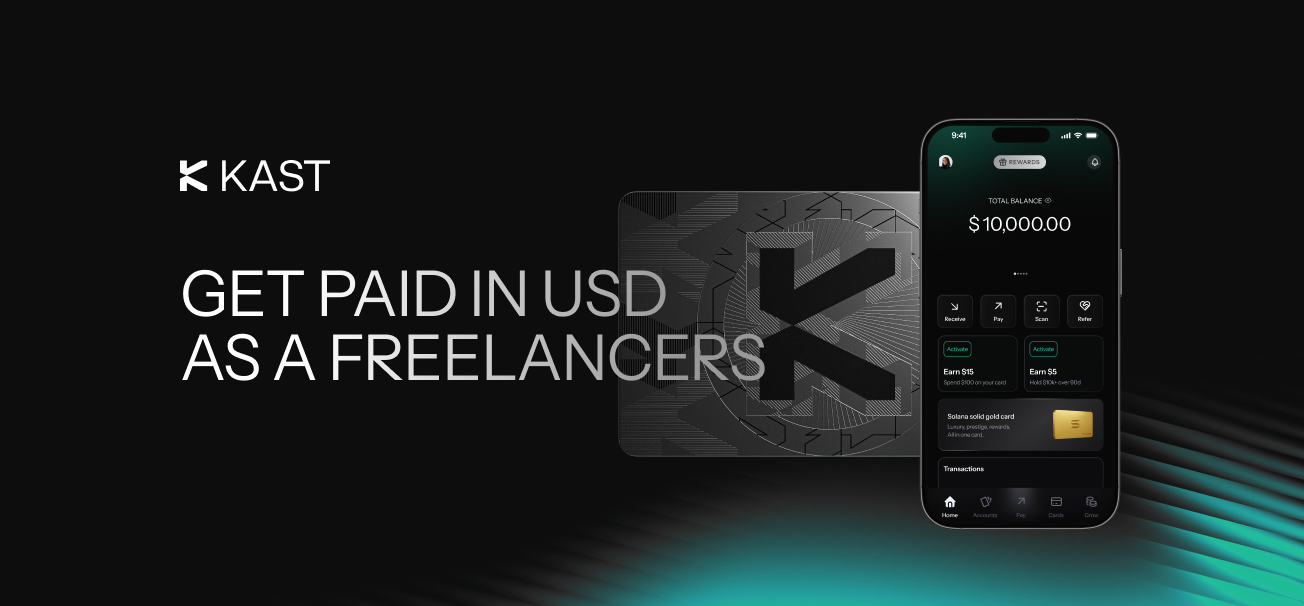
The main value is not only the receiving fee. It is what happens after the money arrives. Freelancers can receive USD value, hold it, spend with the KAST Card where supported, withdraw stablecoins, use local payouts where available, or send USD through SWIFT.
That shorter route can reduce the need to move money across several apps, banks, wallets, or exchanges.
One Simple Example
A freelance designer invoices a client for $1,000.
If the client pays in supported stablecoins, KAST charges 0% to receive the deposit. The KAST receiving cost is $0. External sender fees may still apply.
If the client pays through ACH, the KAST deposit fee is $2.
If the client pays through FedWire, the KAST deposit fee is $15.
That makes supported stablecoin deposits the lowest cost receiving route inside KAST. ACH can work for USD bank payments. FedWire may fit larger or more formal transfers.
Now compare that with a longer route. A freelancer receives money on one platform, converts it, withdraws it to a bank, waits for settlement, then spends from another account.
Even if the first receiving fee looks low, the full route may cost more.
When KAST Makes Sense
KAST makes sense for freelancers who work across borders and need more than one way to receive, use, or send USD value.
It can fit writers, designers, developers, consultants, creators, editors, marketers, and other remote operators paid by global clients.
If a client already uses stablecoins, the payment can move directly into KAST. If the client needs bank rails, KAST supports USD deposits through ACH and FedWire.
After the money arrives, freelancers can choose the next step: spend with the KAST Card where supported, withdraw stablecoins, use local payouts where available, or send USD through SWIFT.
Local payouts use supported domestic banking rails and deliver funds in local currency where available. Availability depends on the currency, destination country, and local rail support.
For freelancers who later operate through a registered company, business-focused options may also become relevant as KAST expands its product suite. This guide focuses on individual freelancer payment routes.
How Freelancers Should Compare USD Payment Routes
The best way to compare payment methods is to check the whole chain.
| Question | Why it matters |
|---|---|
| Can the client pay this way? | A cheap route only works if the client can use it. |
| Does the money arrive in USD or USD value? | Conversion can change the final amount. |
| Is there a receiving fee? | This is the first visible cost. |
| Is there a spread or FX fee? | This can reduce the payout. |
| What does cash out cost? | Some routes become expensive when money leaves. |
| Can you spend directly? | Fewer steps can mean fewer fees. |
| How long does it take? | Delays matter for freelance cash flow. |
For KAST, the cleanest route is usually simple: receive supported stablecoins when possible, use USD ACH or FedWire deposits when the client needs bank rails, then choose card spending, stablecoin withdrawal, local payout, or SWIFT payout based on what you need next.
Fees and availability can change by country, currency, network, transaction type, account status, and provider. Users should check the KAST app or official fee page before sending funds.
Bottom Line
The cheapest route is the one that keeps the payment path short.
For freelancers, that means checking the full cost before choosing how to get paid: receiving, conversion, cash out, spending, and timing.
KAST gives freelancers several ways to manage USD value after payment arrives, so the right route depends on how the client pays and what the freelancer needs next.
Join KAST to receive USD value and manage freelance payments with fewer unnecessary steps.
Disclaimer: This content is for general informational purposes only and does not constitute investment, legal, tax, or financial advice. Digital assets involve high risk and may result in total loss. Please do your own research and consult professional advisors before making any decisions. Read full disclaimer here.